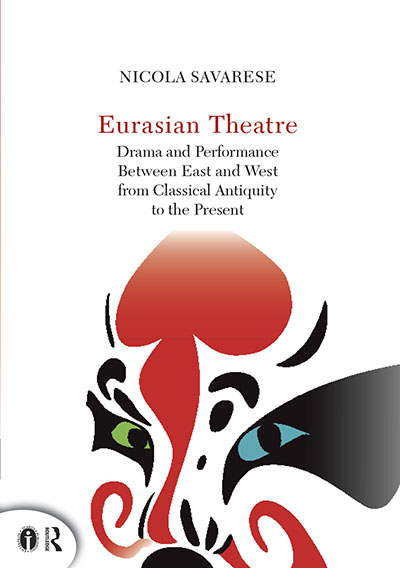
Nicola Savarese, Eurasian Theatre, Drama and Performance
Between East and West from Classical Antiquity to the Present, Translated from
the Italian by Richard Fowler, Updated version revised and edited by Vicki Ann Cremona,
Icarus Publishing Enterprise,
Holstebro -- Malta – Wroclaw, 2010, pp.640
CONTENTS
Preface, by Vicki Ann Cremona; by
Nicola Savarese - I. THE ‘MASCHERA’ OF MARCO POLO. The Exotic
Myth of Asia from Antiquity to the Renaissance - 1. Asia in Tragedy - 2.
Alexander’s Dream - 3. Rome looks to the Orient - 4. Mimes and Pantomimes in Rome
- 5. Byzantine Interludes - 6. Jugglers in the Han Court - 7. Tang Exoticism - 8.
The Students from the Pear Garden - 9. The Fabulous Asia of the Middle Ages - 10.
Tartar Clothing for Marco Polo - 11. Morris Dances and Moorish Figures - 12. Theatre
in the Court of the Great Khan - 13. Danses Macabres - 14. Byzantine Crossroads
- 15. From Constantinople to Istanbul - 16. Costumes from Far--off Countries - 17.
The Moor of Venice - 18. The Prisons of Algiers - II. THE
SAVAGE HARLEQUIN - Oriental Exoticism in European Theatre between the Sixteenth
and Eighteenth Centuries - 1. After the Pepper, the Souls: the Jesuits in
Asia - 2. False Brahmins - 3. Christian Indians and Japanese Martyrs - 4. Local
Colour - 5. Amorous Turks and Gallant Moors - 6. The Fake Turk - 7. In the Name
of the Orient - 8. The Turkish March - 9. Persian Wives and Indian Widows - 10.
Arlequin Sauvage - 11. The Silent Merchants - 12. Idle and Vile Profession - 13.
The Chinese Fashion - 14. Chinese Shadows - 15. A Fundamental Misunderstanding -
16. The Translations of a Chinese Drama - 17. Voltaire’s Edifying Orient - 18. L’Orphelin
de la Chine - III. THE REINCARNATION OF SAKUNTALA
- Oriental Theatres Between the Enlightenment and Romanticism - 1. The Beginnings
of Orientalism - 2. Sakuntala in Europe - 3. Gautier’s Ballet - 4. English Entertainments
in London - 5. William Jones and His Twenty--Eight Tongues - 6. Sir William Discovers
Sakuntala - 7. Theatres in India - 8. English Entertainments in Calcutta - 9. The
Playhouse - 10. Mrs. Bristow’s Little Theatre - 11. Mr. Lebedev’s Theatre - 12.
Philology and Anthropology - 13. The Theatres of Bengal - 14. A Street Theatre -
15. The Dances of the Bayaderes - 16. Romanticism and Orientalism - 17. In Search
of Origins - 18. The Little Clay Cart - IV. AN EMBLEMATIC
PLAY OF MIRRORS - Sada Yacco and Kawakami travel to the West - 1. A Parade
on Broadway - 2. Kawakami Otojiro’s American Tour - 3. The Paris Exposition Universelle
of 1900 - 4. Sada Yacco at the Exhibition - 5. Golden Silk and Flames - 6. A Free
Child - 7. The Students’ Theatre - 8. From Politics to Theatre - 9. Theatre Artists
- 10. The Development of the New Wave - 11. The Second European Tour - 12. The Garden
of the Ten Thousand Pine Trees - 13. Kawakami’s Last Journey - 14. Sada Yacco Retires
from the Stage - 15. Three Continents - 16. The Authority of Apparent Experience
- 17. The Science of Theatre - 18. Spider webs - V. THE
MOBILE ACADEMY - Little Crossroads at the Dawn of the Twentieth Century
- 1. A Lantern and a Bell - 2. The Discovery of Hanako - 3. The Various Talents
of an Impresario - 4. Hanako Discovers She is an Actress - 5. Cambodian Dances -
6. Rodin’s Last Works - 7. Rodin and the New Dance - 8. The King of Cambodia’s Dancers
- 9. The Great Resources - 10. Pioneers of the Rules - 11. The Rediscovered Dance
- 12. Hanako Meets Rodin - 13. The Artist and the Model - 14. Passages - 15. The
Dance of Shiva - 16. Hanako’s Travels - 17. Some Notes on Realism in the Arts -
18. Provisional Conclusions - VI. THE TRADITION OF DIFFERENCE
- Myth and History of Oriental Theatres in the Twentieth Century - 1. The
Dialectic of Exoticism - 2. More About the World Exhibitions - 3. Attractions Large
and Small - 4. Javanese Shadows - 5. Marionettes on the Banks of the Ganges - 6.
The Invention of Tradition - 7. The Destinies of nô - 8. At the Hawk’s Well
- 9. Zeami’s writings - 10. The Magic Pillow - 11. Kabuki in Pigalle - 12. Artaud
Sees Balinese Theatre - 13. Stylization or Biomechanics? - 14. Hear the Movement,
See the Sound - 15. Wind from the East - 16. The Lesson of the Far East - 17. To
Heal a Wound - 18. Borderless Performances - Bibliography Index
The distances that separate East
from West – the two extremes of the Eurasian continent – are enormous. Yet, since
ancient times, the people of Europe and Asia have tried to overcome this remoteness
through a network of trade routes known as the Silk Road. The great migrations,
the continuous military conquests and the paths relentlessly opened up by merchants
have been at the origin of ideological, technical and artistic exchanges, resulting
in a fusion of cultures. Among the ceaseless travellers on the routes of the Silk
Road, along with soldiers, merchants, messengers, and pilgrims, we find those who
earned their living as jugglers, acrobats, musicians, actors and dancers. They were
people who brought with them, rooted in their bodies, their own techniques and histories.
Through these performers, the ‘fabulous and mysterious Orient’ has exerted an ongoing
influence on the art of the theatre in Europe and America. In the same way, especially
in modern times, actors and dancers from India, China, Japan, and other Asian countries
have drawn inspiration from Western dramatic genres for a renewal of their ancient
traditions. A long history of travelling actors moving between East and West has
slowly taken shape, and lies at the foundation of our contemporary, professional
performative arts. This updated and revised edition of Drama and Performance Between
East and West (first published in 1992), traces this history from classical antiquity
to the present. The book constitutes the first complete in-depth historiographic
inquiry into the subject.
Nicola Savarese
(born in Rome, in 1945) is a member of the scientific staff of ISTA, the International
School of Theatre Anthropology founded in 1980 by Eugenio Barba. He was professor
of Performing Arts at the Universities of La Sapienza (Rome), Lecce, Bologna, and
Roma Tre. He has also lectured at the Universities of Kyoto, Montreal, and Sorbonne
III. He has travelled widely in Asia and particularly in Japan, where he lived for
two years. His research and publications focus mainly on the complex dynamics of
the encounters between Asian and Western theatres. His books include, among others:
Il teatro al di la’
del mare (The Theatre
beyond the sea, 1980),
Parigi/Artaud/Bali (1997)
and, in collaboration with Eugenio Barba,
A Dictionary of Theatre Anthropology.
The Secret Art of the Performer
(1997) that has been translated
into many languages. His research on classical Roman theatre, and in particular
on the body-techniques of ancient pantomimes, gave rise to an exhibition inside
the Colosseum in Rome (In
Scaena Catalogue, 2007).
He is also editor of the journals
Teatro e Storia and
Dyonisus ex machina. (www.nicolasavarese.it)